


- OverviewComet 3I/ATLAS is the third known object from outside our solar system to be discovered passing through our celestial neighborhood. Astronomers have categorized this object as interstellar because of the hyperbolic shape of its orbital path. (It does not follow a closed orbital path about the Sun.) When the orbit of 3I/ATLAS is traced into the past, the comet clearly originates from outside our solar system.
Comet 3I/ATLAS poses no threat to Earth and will remain far away. The closest it will approach our planet is about 1.8 astronomical units (about 170 million miles, or 270 million kilometers). 3I/ATLAS will reach its closest point to the Sun around Oct. 30, 2025, at a distance of about 1.4 au (130 million miles, or 210 million kilometers) — just inside the orbit of Mars.
The interstellar comet’s size and physical properties are being investigated by astronomers around the world. 3I/ATLAS should remain visible to ground-based telescopes through September 2025, after which it will pass too close to the Sun to observe. It will reappear on the other side of the Sun by early December 2025, allowing for renewed observations - DiscoveryThe NASA-funded ATLAS (Asteroid Terrestrial-impact Last Alert System) survey telescope in Rio Hurtado, Chile, first reported observations to the Minor Planet Center of comet 3I/ATLAS on July 1, 2025. Since the first report, observations made before the discovery were gathered from the archives of three different ATLAS telescopes around the world and Caltech’s Zwicky Transient Facility at the Palomar Observatory in San Diego County, California. These “pre-discovery” observations extend back to June 14, 2025.
How this comet got its name: Comets are generally named for their discoverer(s), in this case the ATLAS survey team. The letter “I” is for “interstellar,” indicating that this object came from outside our solar system. It’s the third known interstellar object, hence the “3” in the name.Read more about NASA’s discovery of comet 3I/ATLAS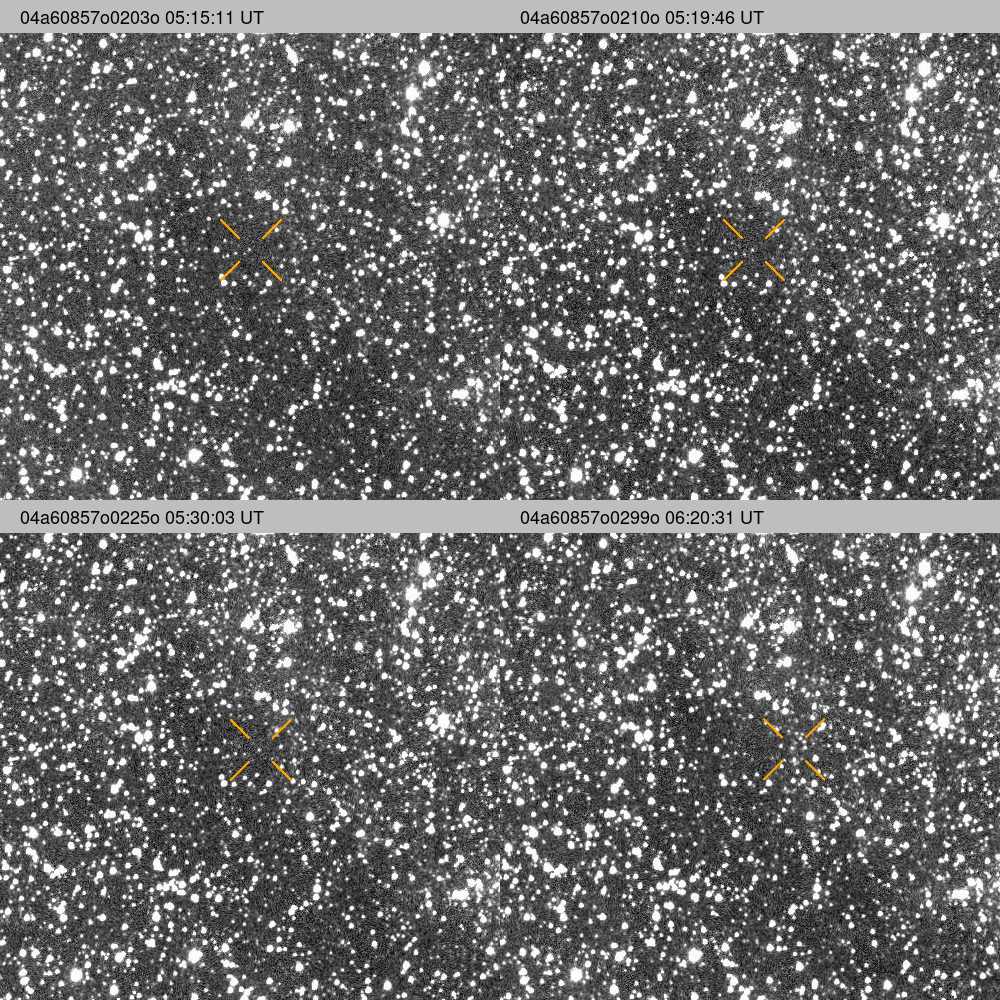 This animation shows the observations of comet 3I/ATLAS when it was discovered on July 1, 2025. The NASA-funded ATLAS survey telescope in Chile first reported that the comet originated from interstellar space.ATLAS/University of Hawaii/NASA
 - NASA Assets Observing Comet 3I/ATLASNASA’s Hubble Space Telescope captured this image of interstellar comet 3I/ATLAS on July 21, 2025, when the comet was 277 million miles from Earth. Hubble revealed a teardrop-shaped cocoon of dust coming off of the comet’s solid, icy nucleus. Because Hubble was tracking the comet moving along a hyperbolic trajectory, the stationary background stars are streaked in the exposure. Hubble’s continuing observations allow astronomers to more accurately estimate the size of the comet’s nucleus. Observations as of Aug. 20, 2025, indicate that the upper limit on its diameter is 3.5 miles (5.6 kilometers), though it could be as small as 1,444 feet (440 meters) across.
NASA assets that are planning to gather observations of 3I/ATLAS include: Hubble, Webb, TESS, Swift, SPHEREx, Perseverance Mars rover, Mars Reconnaissance Orbiter, Curiosity rover, Europa Clipper, Lucy, Psyche, Parker Solar Probe, PUNCH, and ESA/NASA’s SOHO and Juice.
Check back here for observations, schedules, or any additional NASA assets, as that information becomes available.


NASA Assets Observing Comet 3I/ATLASNASA’s Hubble Space Telescope captured this image of interstellar comet 3I/ATLAS on July 21, 2025, when the comet was 277 million miles from Earth. Hubble revealed a teardrop-shaped cocoon of dust coming off of the comet’s solid, icy nucleus. Because Hubble was tracking the comet moving along a hyperbolic trajectory, the stationary background stars are streaked in the exposure. Hubble’s continuing observations allow astronomers to more accurately estimate the size of the comet’s nucleus. Observations as of Aug. 20, 2025, indicate that the upper limit on its diameter is 3.5 miles (5.6 kilometers), though it could be as small as 1,444 feet (440 meters) across.
NASA assets that are planning to gather observations of 3I/ATLAS include: Hubble, Webb, TESS, Swift, SPHEREx, Perseverance Mars rover, Mars Reconnaissance Orbiter, Curiosity rover, Europa Clipper, Lucy, Psyche, Parker Solar Probe, PUNCH, and ESA/NASA’s SOHO and Juice.
Check back here for observations, schedules, or any additional NASA assets, as that information becomes available.

Image: NASA, ESA, David Jewitt (UCLA); Image Processing: Joseph DePasquale (STScI)
team of astronomers has taken the sharpest-ever picture of the unexpected interstellar comet 3I/ATLAS using the crisp vision of NASA’s Hubble Space Telescope. Hubble is one of many missions across NASA’s fleet of space telescopes slated to observe this comet, together providing more information about its size and physical properties. While the comet poses no threat to Earth, NASA’s space telescopes help support the agency’s ongoing mission to find, track, and better understand near-Earth objects.
Hubble’s observations allow astronomers to more accurately estimate the size of the comet’s solid, icy nucleus. The upper limit on the diameter of the nucleus is 3.5 miles (5.6 kilometers), though it could be as small as 1,000 feet (320 meters) across, researchers report. Though the Hubble images put tighter constraints on the size of the nucleus compared to previous ground-based estimates, the solid heart of the comet presently cannot be directly seen, even by Hubble. Observations from other NASA missions including the James Webb Space Telescope, TESS (Transiting Exoplanet Survey Satellite), and the Neil Gehrels Swift Observatory, as well as NASA’s partnership with the W.M. Keck Observatory, will help further refine our knowledge about the comet, including its chemical makeup.
Hubble also captured a dust plume ejected from the Sun-warmed side of the comet, and the hint of a dust tail streaming away from the nucleus. Hubble’s data yields a dust-loss rate consistent with comets that are first detected around 300 million miles from the Sun. This behavior is much like the signature of previously seen Sun-bound comets originating within our solar system.
The big difference is that this interstellar visitor originated in some other solar system elsewhere in our Milky Way galaxy.
3I/ATLAS is traveling through our solar system at a staggering 130,000 miles (209,000 kilometers) per hour, the highest velocity ever recorded for a solar system visitor. This breathtaking sprint is evidence that the comet has been drifting through interstellar space for many billions of years. The gravitational slingshot effect from innumerable stars and nebulae the comet passed added momentum, ratcheting up its speed. The longer 3I/ATLAS was out in space, the higher its speed grew.
“No one knows where the comet came from. It’s like glimpsing a rifle bullet for a thousandth of a second. You can’t project that back with any accuracy to figure out where it started on its path,” said David Jewitt of the University of California, Los Angeles, science team leader for the Hubble observations.
The paper will be published in The Astrophysical Journal Letters. It is already available on Astro-ph.
New Evidence for Population of Wandering Space Relics
“This latest interstellar tourist is one of a previously undetected population of objects bursting onto the scene that will gradually emerge,” said Jewitt. “This is now possible because we have powerful sky survey capabilities that we didn’t have before. We’ve crossed a threshold.»
This comet was discovered by the NASA-funded Asteroid Terrestrial-impact Last Alert System (ATLAS) on July 1, 2025, at a distance of 420 million miles from the Sun. ATLAS is an asteroid impact early warning system developed by the University of Hawai’i.
In the meantime, other NASA missions will provide new insight into this third interstellar interloper, helping refine our understanding of these objects for the benefit of all. 3I/ATLAS should remain visible to ground-based telescopes through September, after which it will pass too close to the Sun to observe, and is expected to reappear on the other side of the Sun by early December.


